

News
Power Outage at Wafer Fab Causes Millions in Losses: How to Reduce Shutdown Risks from the Distribution Side
Reading volume:4 Release time:2026-11-06 15:58:56
Semiconductor wafer fabrication represents one of the most demanding industrial scenarios in terms of power supply continuity. Production lines feature high-precision equipment and lengthy manufacturing processes. Voltage sags, short interruptions and harmonic disturbances in the power distribution system may lead to mass wafer scrap, process shutdown and equipment reset. A single power anomaly in this industry often causes direct production losses in the millions, accompanied by latent impacts such as reduced yield and shortened equipment service life.
Stable power supply for fabs cannot rely solely on energy storage backup systems such as UPS. It is essential to reduce failure risks and mitigate grid disturbances at the source of power distribution, so as to build a multi-layer power assurance system.
I. Key Distribution-Side Causes of Power Anomalies in Wafer Fabs
Many power outages and disturbances do not stem from grid faults alone. Hidden risks and inadequate design within the distribution system are also major contributing factors:
1. Busway failures triggering full-zone outage: Faults such as insulation breakdown and overheated, burned joints on main busways directly cut off power to the corresponding area. Troubleshooting and repair take substantial time, which heavily impacts non-stop wafer production lines;
2. Grid voltage sags disrupting production: Grid voltage sags and swells are the most frequent power disturbances for wafer fabs. Although short in duration, they can trigger protective shutdown of precision equipment and interrupt manufacturing processes;
3. Harmonic interference impairing equipment accuracy: Harmonics generated by numerous precision devices propagate through the distribution network, disrupting the control accuracy of equipment and lowering product yield. In the long run, they also accelerate equipment aging.
II. Building a Multi-Layer Power Assurance System via Power Distribution
To address the above risks, three layers — main power transmission, voltage conditioning and power quality optimization — should be adopted to systematically reduce the risk of power outages and disturbances:
Main Transmission Layer: High-Reliability Busways to Reduce Inherent Failure Risks
The main busway acts as the aorta of the power distribution system, and its reliability forms the foundation of overall power stability.
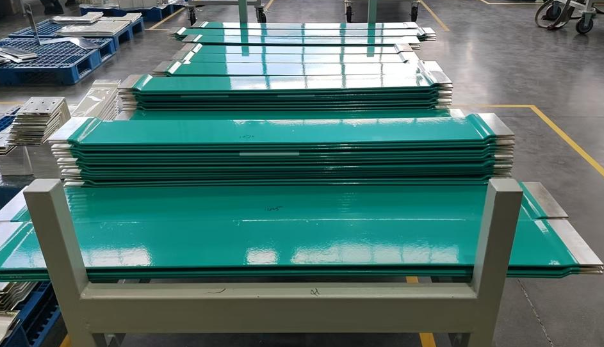
・Monolithic epoxy insulated busways are preferred. Their insulation layers are tightly bonded to conductors without air gaps or splice seams, effectively avoiding common failures of conventional busways including insulation breakdown and joint overheating. Stable long-term performance greatly cuts the risk of outages caused by busway defects;
・For cleanroom environments, the monolithic structure features low particle emission and maintenance-free properties. Frequent cover-opening inspections are unnecessary, minimizing disturbance to the clean environment and reducing human-induced risks during maintenance. Mega Technology’s epoxy fluidized insulated busways have been deployed in multiple semiconductor projects, meeting dual requirements of high reliability and high cleanliness.
Voltage Conditioning Layer: Sag Mitigation to Stabilize Grid Fluctuations
For grid voltage sags, supercapacitor-based DVR (Dynamic Voltage Restorer) units respond to voltage fluctuations within milliseconds and rapidly compensate voltage deviations to maintain stable voltage at the equipment side.
・Ultra-fast millisecond-level response covers most voltage sag events and prevents protective shutdown of precision equipment caused by voltage variations;
・No battery energy storage is required. Featuring long service life and low maintenance cost, it suits continuous long-term industrial operation. Together with the busway system, it forms a complete “transmission + conditioning” solution.
Power Quality Layer: Active Filtering for Clean Power Quality
To tackle harmonic interference, APF (Active Power Filter) units installed in the distribution system dynamically compensate harmonics, reactive power and three-phase unbalance to improve power quality.
・It suppresses harmonics from the 2nd to 50th order, effectively reducing harmonic interference to precision equipment, stabilizing operational accuracy and supporting higher product yield;
・It also improves the system power factor and reduces line losses, balancing power reliability and energy-saving benefits.
III. Full-Link Collaboration: The Core Philosophy of Wafer Fab Power Distribution
Power assurance for wafer fabs is not a simple stack of individual devices, but full-link coordination spanning main transmission to power quality conditioning. Integrated planning of busway reliability, voltage sag mitigation and power quality optimization at the design stage — rather than retrofitting fixes later — delivers the most reliable power system at optimized cost.
Mega Technology delivers an end-to-end power distribution solution for semiconductor wafer fabs combining insulated busways, voltage sag mitigation and power quality optimization. We provide full-cycle support from selection and design to on-site implementation, helping semiconductor manufacturers build a solid foundation for power safety.